Technology Adoption in Modern Workplaces: Trends, Challenges, and Managerial Implications
DOI:
https://doi.org/10.31313/0dbebz48Keywords:
workplace technology, digital transformation, technology adoption, organizational change, systematic review, post-pandemic workAbstract
Background: Technology adoption in modern workplaces has become an increasingly important issue in management and organizational studies, particularly in response to digital transformation, evolving business environments, and post-pandemic work arrangements.
Purpose: This study aims to examine the major trends, challenges, and managerial implications of technology adoption in modern workplaces through a systematic review of the existing literature.
Methods: This study employs a systematic literature review approach by analyzing peer-reviewed articles published between 2010 and 2024. Data were collected from Scopus, Web of Science, and Google Scholar, and 28 studies were selected based on relevance, recency, and methodological rigor.
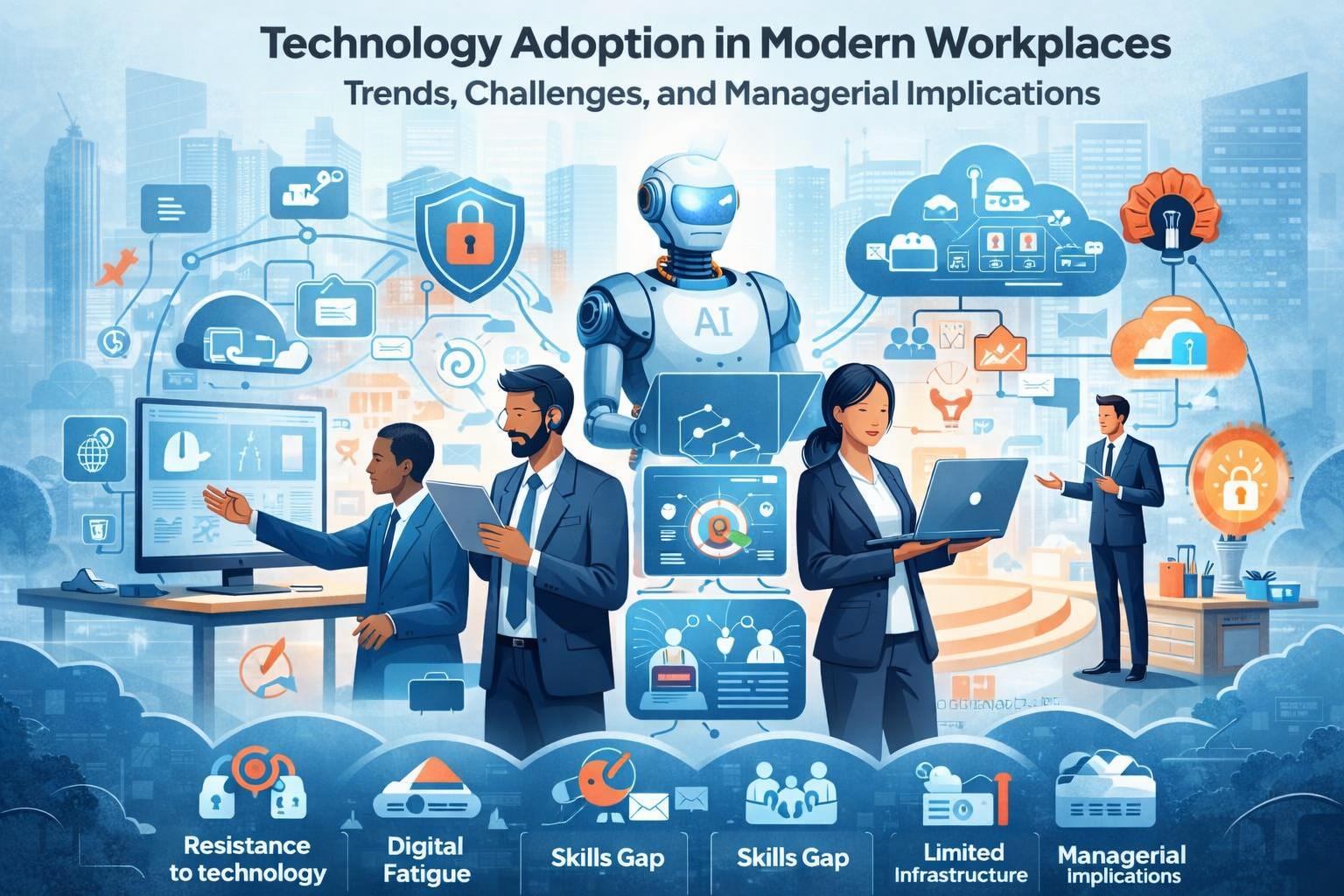
Results: The findings reveal four major trends in workplace technology adoption: the growing use of remote work technologies, increased reliance on automation and artificial intelligence, stronger attention to cybersecurity, and wider implementation of cloud-based collaboration tools. The review also identifies several key challenges, including resistance to change, skills gaps, digital fatigue, and limited technological infrastructure, particularly in developing economies. These findings suggest that technology adoption has significant implications for organizational performance, human resource management, strategic adaptability, and innovation.
Conclusions: Technology adoption in modern workplaces remains essential for improving productivity, flexibility, communication, and organizational effectiveness. Although organizations face various barriers in implementation, the strategic integration of technology is indispensable for sustaining competitiveness in contemporary work environments.
Research Contribution: This study contributes to management literature by providing a comprehensive understanding of the trends, challenges, and managerial implications of workplace technology adoption. It offers useful insights for managers, policymakers, and researchers in developing effective strategies for technology-driven organizational transformation.
References
Abubakar, A. M., Bala, R., & Shneikat, B. H. T. (2020). Technology adoption and digital transformation in the workplace: A review of the literature. Journal of Organizational Change Management, 33(7), 1309–1326. https://doi.org/10.1108/JOCM-04-2019-0108
Ahmad, T., Boit, J., & Aakula, A. (2023). The role of cross-functional collaboration in digital transformation. Journal of Computational Intelligence and Robotics, 3(1), 205–242.
Al-Emran, M., Mezhuyev, V., & Kamaludin, A. (2018). Technology acceptance model in M-learning context: A systematic review. Computers & Education, 125, 389–412. https://doi.org/10.1016/j.compedu.2018.06.008
Azouri, M., Harb, A., Chaaya, L. B., & Akoury, C. (2022). Strategic assessment of factors that create a resistance to change during the implementation of Enterprise Resource Planning (ERP) systems. The case of Lebanese organizations. Arab Economic and Business Journal, 14(2), 18–30.
Chandratreya, A. (2025). Digital transformation and the future workforce. In Transforming the Service Sector With New Technology (pp. 19–40). IGI Global Scientific Publishing.
Chatterjee, S., Chaudhuri, R., & Vrontis, D. (2022). Does remote work flexibility enhance organization performance? Moderating role of organization policy and top management support. Journal of Business Research, 139, 1501–1512.
Davis, F. D. (1989). Perceived usefulness, perceived ease of use, and user acceptance of information technology. MIS Quarterly, 13(3), 319–340. https://doi.org/10.2307/249008
Dwivedi, Y. K., Rana, N. P., Jeyaraj, A., Clement, M., & Williams, M. D. (2019). Re-examining the unified theory of acceptance and use of technology (UTAUT): Towards a revised theoretical model. Information Systems Frontiers, 21(3), 719–734. https://doi.org/10.1007/s10796-017-9774-y
Giannakos, M. N., Mikalef, P., & Pappas, I. (2021). Systematic literature review of Elearning capabilities to enhance organizational learning. Information Systems Frontiers, 1–17. https://doi.org/10.1007/s10796-020-10097-2
Gupta, S., Tuunanen, T., Kar, A. K., & Modgil, S. (2023). Managing digital knowledge for ensuring business efficiency and continuity. Journal of Knowledge Management, 27(2), 245–263.
Haber, L., & Carmeli, A. (2023). Leading the challenges of implementing new technologies in organizations. Technology in Society, 74, 102300.
Hameed, M. A., Counsell, S., & Swift, S. (2012). A meta-analysis of relationships between organizational characteristics and IT innovation adoption in organizations. Information & Management, 49(5), 218–232.
Hesselbarth, Y., Alfes, K., & Festing, M. (2024). Understanding technology-driven work arrangements from a complexity perspective: a systematic literature review and an agenda for future research. The InTernaTIonal Journal of Human Resource ManagemenT, 35(5), 964–1006.
Leesakul, N., Oostveen, A.-M., Eimontaite, I., Wilson, M. L., & Hyde, R. (2022). Workplace 4.0: Exploring the implications of technology adoption in digital manufacturing on a sustainable workforce. Sustainability, 14(6), 3311.
Nair, J., Chellasamy, A., & Singh, B. N. B. (2019). Readiness factors for information technology adoption in SMEs: testing an exploratory model in an Indian context. Journal of Asia Business Studies, 13(4), 694–718.
Rogers, E. M., Singhal, A., & Quinlan, M. M. (2014). Diffusion of innovations. In An integrated approach to communication theory and research (pp. 432–448). Routledge.
Saad, M. H., Hagelaar, G., Van Der Velde, G., & Omta, S. W. F. (2021). Conceptualization of SMEs’ business resilience: A systematic literature review. Cogent Business & Management, 8(1), 1938347.
Saeed, S., Altamimi, S. A., Alkayyal, N. A., Alshehri, E., & Alabbad, D. A. (2023). Digital transformation and cybersecurity challenges for businesses resilience: Issues and recommendations. Sensors, 23(15), 6666.
Sarfraz, M., Ivascu, L., & Abdullah, M. I. (2022). Sustainable digital economy, entrepreneurship, and blockchain technology role in industrial-organizational psychology. In Frontiers in Psychology (Vol. 13, p. 974415). Frontiers Media SA.
Şişu, J. A., Tîrnovanu, A. C., Mujaya, N. J., Ito, S., & Obreja, M.-M. (2024a). The role of digital solutions in enhancing organizational efficiency. Revista de Management Comparat International, 25(4), 764–774.
Şişu, J. A., Tîrnovanu, A. C., Mujaya, N. J., Ito, S., & Obreja, M.-M. (2024b). The role of digital solutions in enhancing organizational efficiency. Revista de Management Comparat International, 25(4), 764–774.
Suhada, S., Wulandari, N. D., Idries, F. A., Pratiwi, N., Oktariantra, I., Romandhani, A. O., & Riyadho, A. (2026). The role of digital skills, digital self-efficacy, and government support in enhancing digital work readiness.
Ursavaş, Ö. F. (2022). Unified theory of acceptance and use of technology model (UTAUT). In Conducting technology acceptance research in education: Theory, models, implementation, and analysis (pp. 111–133). Springer.
Valtonen, A., & Holopainen, M. (2025). Mitigating employee resistance and achieving well-being in digital transformation. Information Technology & People, 38(8), 42–72.
Venkatesh, V., Morris, M. G., Davis, G. B., & Davis, F. D. (2003). User acceptance of information technology: Toward a unified view. MIS Quarterly, 27(3), 425–478. https://doi.org/10.2307/30036540
Wang, B., Liu, Y., & Parker, S. K. (2020). How does the use of information communication technology affect individuals? A work design perspective. Academy of Management Annals, 14(2), 695–725.
Wolor, C. W., Nurkhin, A., & Citriadin, Y. (2021). Leadership style for millennial generation, five leadership theories, systematic literature review. Quality - Access to Success, 22(184), 105–110. https://doi.org/10.47750/QAS/22.184.13
Yoo, Y., Henfridsson, O., & Lyytinen, K. (2010). Research commentary—The new organizing logic of digital innovation: An agenda for information systems research. Information Systems Research, 21(4), 724–735. https://doi.org/10.1287/isre.1100.0322
Zhao, Y., Ni, Q., & Zhou, R. (2018). What factors influence the mobile health service adoption? A meta-analysis and the moderating role of age. International Journal of Information Management, 43, 342–350. https://doi.org/10.1016/j.ijinfomgt.2017.08.006
Downloads
Published
Data Availability Statement
Data sharing is not applicable to this article because no new data were created or analyzed in this study.
Issue
Section
License
Copyright (c) 2026 Samuel Nssien, Afolami Afolami, Feyikemi Feyikemi (Author)

This work is licensed under a Creative Commons Attribution-ShareAlike 4.0 International License.
Copyright
Authors who publish with this journal agree to the following terms:
- Authors retain copyright and grant the journal right of first publication with the work simultaneously licensed under a Creative Commons Attribution-ShareAlike 4.0 International License that allows others to share the work with an acknowledgment of the work's authorship and initial publication in this journal.
- Authors are able to enter into separate, additional contractual arrangements for the non-exclusive distribution of the journal's published version of the work (e.g., post it to an institutional repository or publish it in a book), with an acknowledgment of its initial publication in this journal.
- Authors are permitted and encouraged to post their work online (e.g., in institutional repositories or on their website) prior to and during the submission process, as it can lead to productive exchanges, as well as earlier and greater citation of published work (See The Effect of Open Access).
License

This work is licensed under a Creative Commons Attribution-ShareAlike 4.0 International License.
You are free to:
- Share — copy and redistribute the material in any medium or format for any purpose, even commercially.
- Adapt — remix, transform, and build upon the material for any purpose, even commercially.
- The licensor cannot revoke these freedoms as long as you follow the license terms.
Under the following terms:
- Attribution — You must give appropriate credit , provide a link to the license, and indicate if changes were made . You may do so in any reasonable manner, but not in any way that suggests the licensor endorses you or your use.
- ShareAlike — If you remix, transform, or build upon the material, you must distribute your contributions under the same license as the original.
- No additional restrictions — You may not apply legal terms or technological measures that legally restrict others from doing anything the license permits.
Notices:
You do not have to comply with the license for elements of the material in the public domain or where your use is permitted by an applicable exception or limitation .
No warranties are given. The license may not give you all of the permissions necessary for your intended use. For example, other rights such as publicity, privacy, or moral rights may limit how you use the material.