A Bibliometric Analysis of E-Purchasing Implementation in Public Sector Procurement of Goods and Services in Indonesia, 2019–2024
DOI:
https://doi.org/10.31313/kjm.v1i1.9Keywords:
procurement, e-purchasing, public sector, bibliometric analysis, IndonesiaAbstract
Background: The implementation of e-purchasing in the procurement of goods and services has become an important part of public sector governance reform in Indonesia. Along with the acceleration of digital transformation, research on e-purchasing has grown significantly and reflects increasing attention to transparency, efficiency, and accountability in public procurement.
Purpose: This study aims to analyze the development of research on the implementation of e-purchasing in public sector procurement in Indonesia during the 2019–2024 period and to identify major publication trends, thematic clusters, and challenges discussed in the literature.
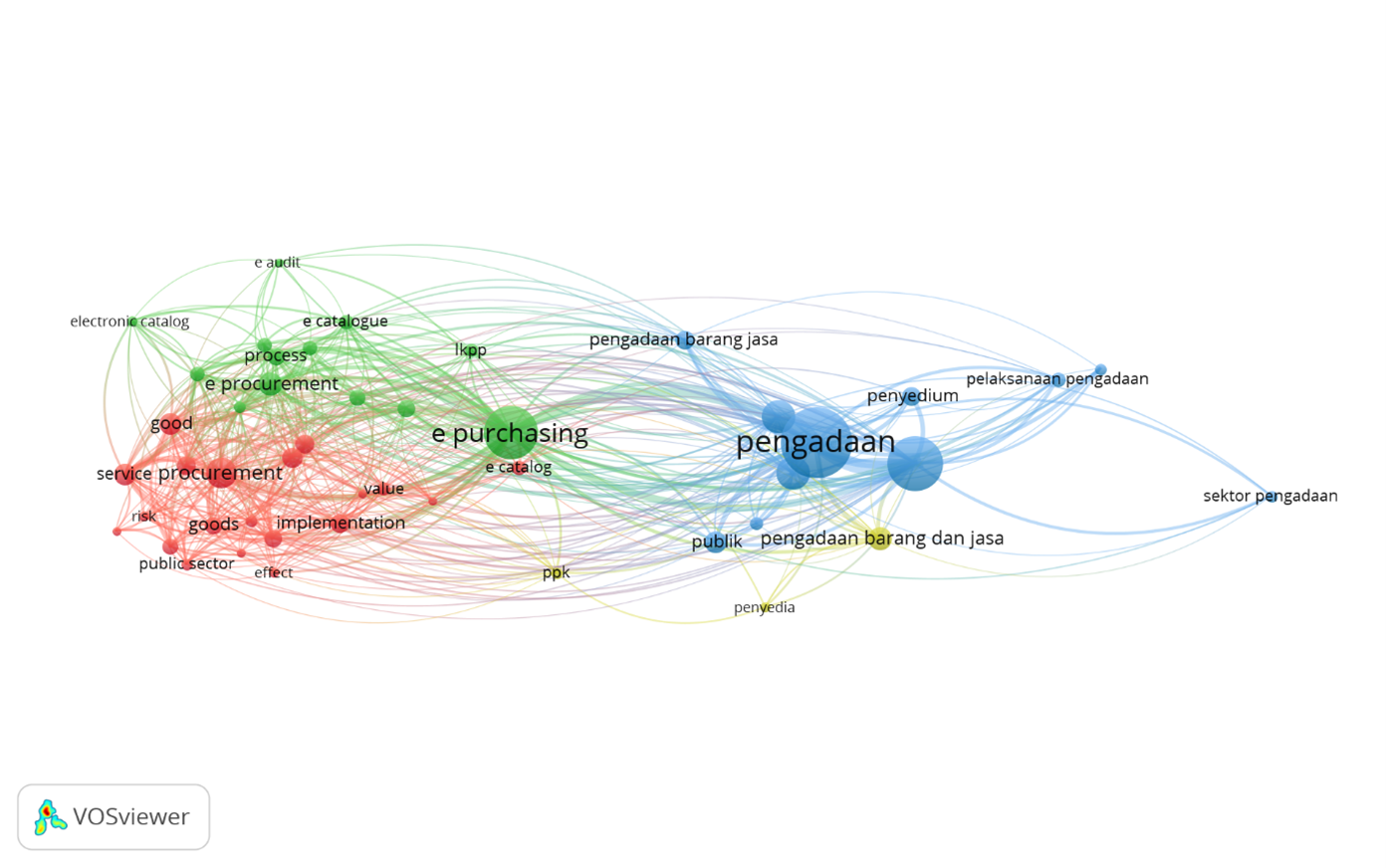
Methods: This study applies a bibliometric approach using data obtained from the Google Scholar database. Data were collected and filtered using Publish or Perish (PoP), while mapping and visualization analyses were conducted using VOSviewer. The analysis focuses on publication growth, keyword co-occurrence, research clustering, and the evolution of terms used in the literature.
Results: The findings show a significant annual increase in publications related to e-purchasing, with a total of 537 articles identified during the study period. The bibliometric mapping reveals four major research clusters that represent the main themes in the literature. The study also identifies several barriers to e-purchasing implementation, including limited human resources and resistance to changes in work culture. In addition, the analysis indicates a shift in the terminology used across publications over time.
Conclusions: Research on e-purchasing in Indonesia’s public sector procurement has developed rapidly over the last six years. The growing number of publications and thematic variations indicate that e-purchasing has become an increasingly relevant topic in efforts to improve procurement governance. However, implementation challenges remain, particularly in terms of human resource capacity and organizational adaptation
Research Contribution: This study contributes to the literature by providing a comprehensive bibliometric overview of e-purchasing research in Indonesia’s public sector procurement. It offers insights into research trends, thematic developments, and implementation barriers that may support future studies and inform policy improvement.
References
Ayobami, A. T., Mike-Olisa, U., Ogeawuchi, J. C., Abayomi, A. A., & Agboola, O. A. (2024c). Digital procurement 4.0: Redesigning government contracting systems with AI-driven ethics, compliance, and performance optimization. International Journal of Scientific Research in Computer Science, Engineering and Information Technology, 10(2), 834–865.
Babica, V., Sceulovs, D., & Rustenova, E. (2019). Digitalization of public procurement: Barriers for innovation. Proceedings of the 23rd World Multi-Conference on Systemics, Cybernetics and Informatics: WMSCI, 6.
Batool, S., Gill, S. A., Javaid, S., & Khan, A. J. (2021). Good governance via E-Governance: moving towards digitalization for a digital economy. Review of Applied Management and Social Sciences, 4(4), 823–836.
Firmansyah, A., Maulana, R. Y., & Miftah, A. Z. (2024a). Transformation of the procurement system in the Indonesian government. Sosiohumaniora, 26(2), 369–381.
Firmansyah, A., Maulana, R. Y., & Miftah, A. Z. (2024b). Transformation of the procurement system in the Indonesian government. Sosiohumaniora, 26(2), 369–381.
Hakim, L. (2020). Analisis Bibliometrik penelitian inkubator bisnis pada publikasi ilmiah terindeks Scopus. Procuratio: Jurnal Ilmiah Manajemen, 8(2), 176–189.
Hassan, W., & Duarte, A. E. (2024). Bibliometric analysis: a few suggestions. Current Problems in Cardiology, 49(8), 102640.
Hochstetter, J., Vásquez, F., Diéguez, M., Bustamante, A., & Arango-López, J. (2023). Transparency and E-government in electronic public procurement as sustainable development. Sustainability, 15(5), 4672.
Jiménez, A., Hanoteau, J., & Barkemeyer, R. (2022). E-procurement and firm corruption to secure public contracts: The moderating role of governance institutions and supranational support. Journal of Business Research, 149, 640–650.
Lenggogeni Amelia Puti Chaidir, & Elisa Susanti. (2024). Implementasi E-Purchasing pada Proses Pengadaan Barang dan Jasa Secara Elektronik di Kecamatan Tebet Jakarta Selatan. El-Mal: Jurnal Kajian Ekonomi & Bisnis Islam, 5(8), 3615–3635. https://doi.org/10.47467/elmal.v5i8.3539
Lestary, V. S., Zulfah, Z., & Astuti, A. (2023). Analisis bibliometrik: fokus penelitian problem based learnig dalam pembelajaran matematika. Jurnal Ilmiah Matematika Realistik, 4(1), 120–125.
Liu, H., Jiang, Y., Fan, H., Wang, X., & Zhao, K. (2021). Visualization analysis of knowledge network research based on mapping knowledge. Journal of Signal Processing Systems, 93(2), 333–344.
Melnyk, L. H., Kubatko, O. V., Piven, V. S., Klymenko, K., & Rybina, L. (2021). Digital and economic transformations for sustainable development promotion: A case of OECD countries.
Mohungoo, I., Brown, I., & Kabanda, S. (2020). A systematic review of implementation challenges in public e-procurement. Conference on E-Business, e-Services and e-Society, 46–58.
Nurhidayat, I. (2023). Prinsip-prinsip good governance di Indonesia. Journal Education and Government Wiyata, 1(1), 40–52.
Passas, I. (2024). Bibliometric analysis: the main steps. Encyclopedia, 4(2).
Peraturan Lembaga Kebijakan Pengadaan Barang/Jasa Pemerintah Nomor 9 Tahun 2021 Tentang Toko Daring Dan Katalog Elektronik Dalam Pengadaan Barang/Jasa Pemerintah (2021).
Rannie, M., Saraswati, R., & Wisnaeni, F. (2024). Does the Reform of the Parliamentary and Presidential Threshold Strengthen the Presidential System in Indonesia? Sriwijaya Law Review, 8(1), 133.
Salam, U., Lee, S., Fullerton, V., Yusuf, Y., Krantz, S., & Henstridge, M. (2018). Indonesia case study: Rapid technological change–challenges and opportunities. Pathways for Prosperity Commission Background Paper Series, 1(1), 2009–2019.
Yuslina, R., Rahayu, N. S., & Silitonga, M. S. (2026). Strategy for Electronic Procurement of Good/Services Through Electronic Catalogues at the Ministry of Cooperatives. Eduvest-Journal of Universal Studies, 6(2), 1650–1662.
Downloads
Published
Data Availability Statement
Data sharing is not applicable to this article because no new data were created or analyzed in this study.
Issue
Section
License
Copyright (c) 2026 Tata Tiara Dwi Indrianti (Author)

This work is licensed under a Creative Commons Attribution-ShareAlike 4.0 International License.
Copyright
Authors who publish with this journal agree to the following terms:
- Authors retain copyright and grant the journal right of first publication with the work simultaneously licensed under a Creative Commons Attribution-ShareAlike 4.0 International License that allows others to share the work with an acknowledgment of the work's authorship and initial publication in this journal.
- Authors are able to enter into separate, additional contractual arrangements for the non-exclusive distribution of the journal's published version of the work (e.g., post it to an institutional repository or publish it in a book), with an acknowledgment of its initial publication in this journal.
- Authors are permitted and encouraged to post their work online (e.g., in institutional repositories or on their website) prior to and during the submission process, as it can lead to productive exchanges, as well as earlier and greater citation of published work (See The Effect of Open Access).
License

This work is licensed under a Creative Commons Attribution-ShareAlike 4.0 International License.
You are free to:
- Share — copy and redistribute the material in any medium or format for any purpose, even commercially.
- Adapt — remix, transform, and build upon the material for any purpose, even commercially.
- The licensor cannot revoke these freedoms as long as you follow the license terms.
Under the following terms:
- Attribution — You must give appropriate credit , provide a link to the license, and indicate if changes were made . You may do so in any reasonable manner, but not in any way that suggests the licensor endorses you or your use.
- ShareAlike — If you remix, transform, or build upon the material, you must distribute your contributions under the same license as the original.
- No additional restrictions — You may not apply legal terms or technological measures that legally restrict others from doing anything the license permits.
Notices:
You do not have to comply with the license for elements of the material in the public domain or where your use is permitted by an applicable exception or limitation .
No warranties are given. The license may not give you all of the permissions necessary for your intended use. For example, other rights such as publicity, privacy, or moral rights may limit how you use the material.